Continue with
If you run a specialist clinic in Australia and you are currently using a medical transcription service, an in-house typist, or an outsourced transcription workflow, this page is for you. Here is a quick comparison of the main options operating in Australia, including where AI clinical documentation fits in.
External typist companies rely on offshore email queues or generic chatbots, both of which introduce significant security and privacy risks. When using offshore transcription, sensitive patient data is sent overseas to people you have never met, often moving outside the protection of Australian data sovereignty laws. Meanwhile, generic chatbots carry their own hidden cost: your data. Much like how Meta and other large tech companies absorb user inputs to train their massive global algorithms, generic AI tools can ingest your highly confidential clinical consultations to train their future public models. They also leave you to troubleshoot alone.
Medow is different. Built on strict privacy by design principles, your patient data is processed locally in Australia and is never used to train third-party AI systems. Behind every clinic is a dedicated, local Customer Success Manager who knows your preferences. And behind that CSM sits a team of technicians and in-house doctors. You'll never have to navigate the world of AI aloneExternal typist companies rely on offshore email queues or generic chatbots. They leave you to troubleshoot alone. Medow is different. Behind every clinic is a dedicated, local Customer Success Manager who knows your preferences. And behind that CSM sits a team of technicians and in-house doctors. You'll never have to navigate the world of AI alone.
The rest of this page explains how each model works, where traditional transcription services fall short for specialist clinics, and how Medow differs in practice.
Several well-established transcription services operate in Australia, serving specialist clinics alongside GPs, hospitals, and medicolegal practices. The main providers are:
Australian-owned and operated since 2002, Pacific Transcription is one of the largest and longest-established medical transcription providers in the country. They hold ISO 27001 and ISO 9001 certification, serve GP, specialist, and hospital clients, and offer standard and express turnaround options. Billing is audio minute. Volume discounts are available for high-volume clients. They support PMS integration for importing transcripts back into practice software.
OutScribe was founded in Adelaide in 2005 and uses 100% Australian transcriptionists. They cover a wide range of medical specialties including radiology, oncology, cardiology, and psychiatry. Billing is per audio minute, with the rate set by the turnaround time chosen: same-day through to 7 days. Clients can upload custom templates.
Access Transcription is Australian-owned and managed, with transcription performed by medical graduates (primarily registered nurses) at secure premises in the Philippines. They are the largest outsourced transcription provider for radiology in Australia, with 70% of their business in that specialty, and also cover cardiology, neurology, gynaecology, and general surgery. The offshore model is positioned on cost. They claim 50% or more in savings compared to in-house typist costs. Available 24/7.
Medow is not a transcription service. It is a Specialist-grade AI clinical documentation platform built for specialist private clinics in Australia and New Zealand. Rather than returning a transcript for you to format and edit, Medow generates finished letters and reports directly from your consult recording, using a dedicated AI model trained per specialty and style of writing. It integrates with Genie and Gentu, Elixir and Shexie via deep API for instantaneous workflows. The reason it appears in this comparison: for specialist clinics evaluating whether to continue with a transcription service, Medow is the primary alternative.
Medical transcription is the conversion of a doctor's spoken clinical notes into written text. A specialist records a consultation or dictates notes after seeing a patient. That audio goes to a transcription provider or in-house typist and comes back as a typed document.
In Australian specialist clinics, this takes one of three forms:
In all three cases, the output is a transcript. The specialist then uses that transcript to draft referral letters, consult notes, and clinical reports. That second step is separate from transcription, and it is where most of the administrative time actually sits.
Most specialist clinics that use transcription services outsource the work rather than employ a dedicated typist. The outsourcing model has practical advantages: no staffing overhead, flexible volume, and access to typists with medical terminology training.
The standard outsourced workflow:
That final step is where the burden concentrates for specialist clinics. Outsourced transcription moves the typing offsite. It does not move the formatting, structure, or clinical correspondence writing. That remains with you.
For most specialist clinics, medical transcription services solve one step in a multi-step problem. If the goal is an accurate written record of the consult, human transcription services deliver that reliably. If the goal is to reduce the total time you spend on letters and reports, transcription solves only part of it.
Seeing 20 patients a day, each generating 10 minutes of audio, means you are not just outsourcing 200 minutes of typing. The transcript still needs to be formatted and turned into the finished output. That step stays with you.
Cost is the other factor. Per-line or per-audio-minute billing means your transcription spend scales directly with clinical activity. A busier clinic pays proportionally more. A flat-fee platform does not.
Even the fastest outsourced services return audio within 24 hours on standard turnaround. Express options cost more. For specialists aiming to dispatch referral letters on the day of the consult, this creates a backlog that requires significant admin effort to manage.
A transcript is not a finished clinical letter. Specialist outpatient letters, procedure reports, and referral correspondence all have specific structure and formatting requirements. Converting a raw transcript into the correct output is a step that transcription services do not cover, and it is where the heaviest administrative burden sits.
Accuracy depends on whether the typist has experience in your specific field. General transcription handles general medical language adequately. Subspecialty terminology in cardiology, gastroenterology, and oncology is harder. Accuracy varies by service and individual typist assignment.
Per-line or per-audio-minute billing means costs grow with every extra patient. The table below gives a rough indication of monthly transcription spend for a typical specialist clinic:
*Estimates based on typical Australian transcription rates. Billing models vary: per-line with some providers, per-audio-minute with others (for example OutScribe). Actual costs depend on provider, turnaround speed, and volume. Does not include in-house typist salary where applicable.
Outsourced transcription services return text via a portal or email, with no automated pathway into Genie, Gentu, or other specialist PMS. Getting the transcript into the patient record requires a manual step. For multi-room clinics, this adds up quickly.
See how the full workflow looks for your specialty.
Book a 30-minute demo to see Medow handle recording, transcription, and finished letters and reports without the separate formatting step.
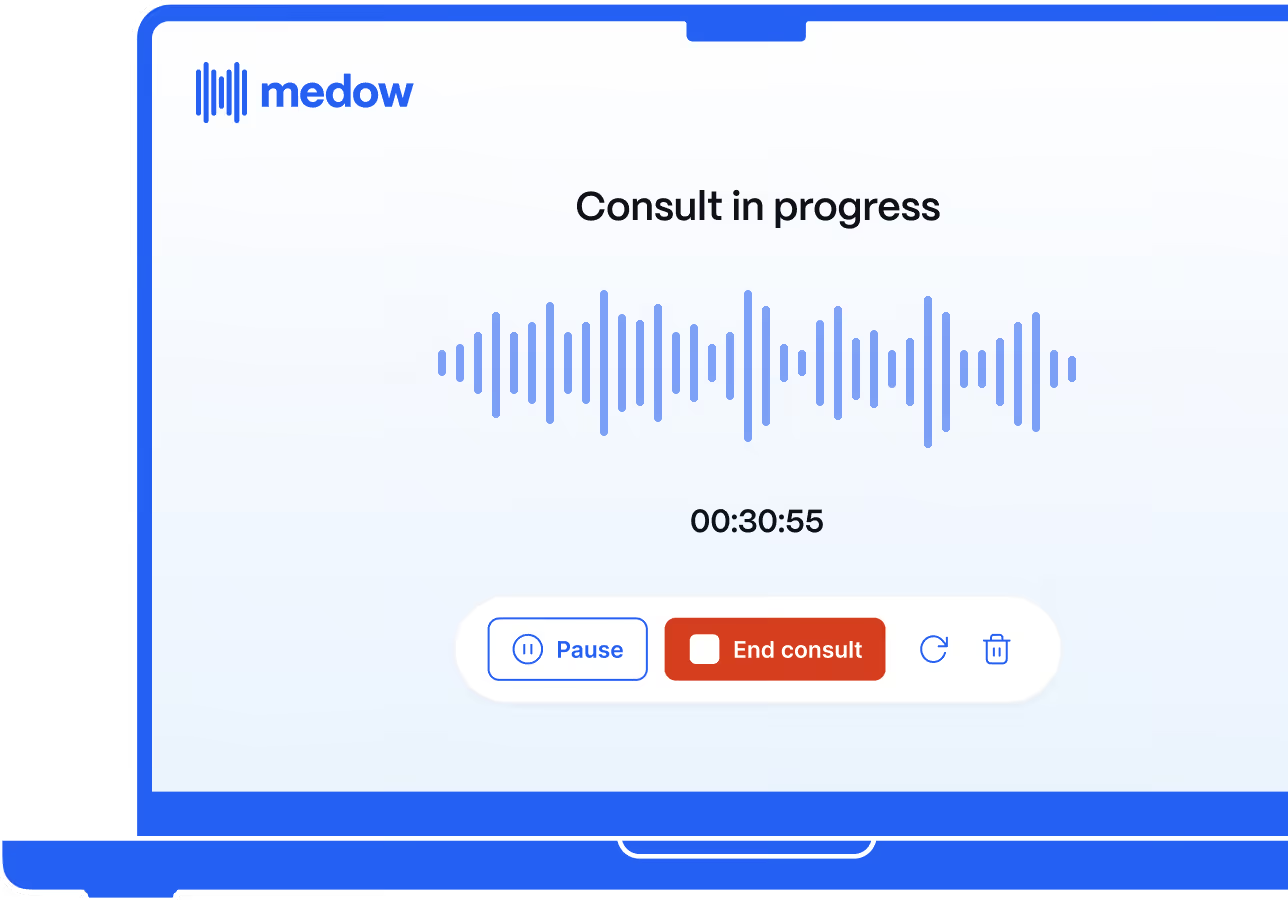
Medow sits inside the consult rather than downstream of it. It listens in real time, transcribes during the appointment, and generates finished letters and reports before your next patient is seen. You review and approve the output rather than writing it from a raw transcript.
Medow is a Specialist-grade AI clinical documentation platform built for specialist clinics in Australia, New Zealand, and Singapore. It runs a dedicated AI model per specialty, trained on the terminology, clinical workflows, and output structures of each field. It sounds unmistakably like you: your tone, your structure, your preferences, set up before you see your first patient.
The key difference is what lands in your hands. Outsourced transcription moves the typing offsite but keeps the formatting and correspondence writing with you. Medow moves both: it handles transcription and generates the finished output. Your role becomes review and approval, not drafting.
You would not expect a GP to write a cardiology report. Medow does not use a generic model with templates pasted on top. There is a dedicated model for your specialty, trained on the terminology, abbreviations, and output structures of your field. TTE lands as transthoracic echocardiogram. The clinical language is right because the model was built for your specialty, not adapted toward it.
Medow connects directly to Genie, Gentu, Elixir and Shexie via deep API integration. Letters and consult notes flow into the patient record without a separate upload step. For clinics running multiple consulting rooms, this removes a material administrative bottleneck. For more on the AI transcription component, see why our AI medical scribe is so accurate.
Behind every Medow clinic sits a dedicated local Customer Success Manager who knows your practice, your preferences, and your dictation style. You will never have to navigate the world of AI alone. And behind your CSM sits a multi-tiered team: AI engineers for technical needs, and in-house clinicians when you need a medical conversation. Medow does the work for you.
The recording step does not change. You still speak during or after the consult. What changes is everything downstream. Instead of audio going offsite to a typist and returning as a transcript to reformat, Medow generates the finished letter or report directly.
Onboarding is high-touch by design. Your dedicated Customer Success Manager configures the platform before you see your first patient: your clinic letterheads, preferred report structures, letter templates, and tone, set up in advance. The first weeks run with the CSM reviewing outputs alongside you to refine the model to your style.
For clinics currently using a transcription service, the admin team's role shifts rather than disappears. Most clinics find admin staff move from transcription-related tasks toward patient coordination once Medow is running.
"Medow Health has lifted such a weight - no more going into the weekend thinking about dictation and no outstanding letters from this year."


"Medow Health has completely transformed the way I work. It flows beautifully, capturing everything I need for my letters, which are now always finished by the end of my clinic. I used to spend my weekends catching up on letters and it felt like a constant weight around my neck. Now, that weight is gone - it’s saved me so much time and brought balance back to my life. I truly couldn’t imagine practicing without it!"


For a detailed comparison of transcription software platforms against AI medical scribe, see our comparison of medical transcription software vs AI medical scribe. To understand how AI medical scribes work for specialist clinics in Australia, see our guide to AI medical scribes for Australian specialist clinics.
No more outstanding letters at the end of clinic.
No retyping. No reformatting. Ready to sign.
Book a 30-minute demo with the Medow team. See your specialty's terminology, your practice management system, and your preferred letter and report formats, working from day one.
Try it for 60 days with a money-back guarantee.
The main Australian medical transcription services are Pacific Transcription, OutScribe, and Access Transcription. Pacific Transcription is Australian-owned, onshore, ISO 27001 certified, and bills per audio minute. OutScribe is Australian-staffed, bills per audio minute, and offers same-day turnaround. Access Transcription is Australian-managed with transcription performed offshore in the Philippines, and is the largest provider for radiology specifically. All three return transcripts, not finished clinical letters or reports.
Outsourced transcription converts audio to text and returns a transcript. Medow converts audio to text and then generates the finished letter or report. You receive a draft output to review and approve rather than a raw transcript to reformat. Medow also integrates directly with Genie and Gentu, so letters flow into the patient record without a separate upload step.
Per-line or per-minute pricing is predictable but scales directly with clinical activity. It also excludes the time you spend converting transcripts into finished clinical correspondence. Medow charges a flat subscription that does not grow with patient volume, and it reduces total time spent on letters and reports by generating the finished output rather than a transcript to edit.
The transition is underway but gradual. Human transcription services remain widely used in GP and specialist settings. The clearest shift is in specialist private clinics, where the demand for same-day correspondence and PMS integration makes AI documentation a more practical fit. Transcription services handle one step of the process. Medow handles all of it.