Best Medical Dictation Software for Specialist Clinics in Australia 2026

The best medical dictation software for a specialist clinic is not simply the one with the highest speech-to-text accuracy. The category has split in two. On one side: Dragon Medical One and its long-established verbatim transcription model, where the doctor dictates every word and every comma and Dragon writes down exactly that. On the other: AI medical scribes that record the consultation and rewrite what was said into a structured note in the model’s own language.

For specialists who have dictated for years, neither extreme is quite right. Dragon is reliable but requires spoken punctuation and leaves the doctor to structure and format every letter manually. AI scribes are fast but generate the letter in the model's own language, which specialists with strong dictation habits often find themselves editing more than they expected. Medow's Smart Dictation removes the spoken-punctuation step, applies an Australian-localised dictionary, and assigns dictated content to the correct sections of the letter automatically — the doctor's words stay the doctor's words.

Medow Smart Dictation is a third path: your exact words and phrasing (with AI removing vocal stutters and misinterpreted accents), a Specialty-grade AI model assigning each sentence to the right section of the letter, automatic punctuation and formatting, and bi-directional sync into the PMS. Specialists switching from traditional dictation report meaningful reductions in per-letter time — not because an AI is writing the letter for them, but because the post-dictation structuring, formatting and copy/paste work has been automated.

This guide covers the three main medical dictation software options available to Australian specialist clinics in 2026 — Dragon Medical One, i-Scribe, and Medow Smart Dictation — alongside the traditional typist workflow many specialists still use. We assess each on the criteria that matter most to specialist practice: AI model quality, reports and letters output, ANZ PMS integration depth, and setup and support.

AI Medical Scribe Australia: What Specialist Clinics Need to Know
1. Our pick for specialist clinics: Medow Smart Dictation

2. Dedicated Specialty-grade AI model per medical specialty: not a general-purpose speech engine

3. No punctuation commands: speak naturally, the AI structures and formats the output

4. Verbatim words kept intact: your phrasing, your style, in the right sections of the letter

5. Full reports and letters: consult notes, GP letters, referrals, patient letters, operation reports

6. Deep bi-directional API integrations with Genie, Gentu, Shexie, Elixir, and Meditech

7. Dedicated Customer Success Manager configures templates and PMS before go-live

8. Smart Dictation and ambient AI Scribe in one platform: one subscription, both modes

9. 60-day money-back guarantee
Book a demo to see Medow Smart Dictation in your specialist clinicSee how Medow Smart Dictation works

Why This Comparison Exists

Many Australian specialist doctors have used Dragon Medical One or a typist at some point. Both have been the category default for decades, and for clinicians with highly structured dictation habits they continue to deliver real value, within the limits of what verbatim transcription, on its own, can do.

The case for switching is not primarily about moving to AI. It is about editing time. With Dragon Medical One the clinician still speaks punctuation, structures the letter manually, and copies the result into the PMS. Medow’s Smart Dictation handles punctuation, structuring, and PMS sync automatically — the doctor speaks naturally and the formatted, PMS-synced letter is ready for review in seconds. Time previously spent correcting and organising output is returned to clinical work.

For specialists looking for a Dragon Medical One alternative that removes those specific steps without removing control over the letter, Medow Smart Dictation is built for exactly that transition. A significant portion of Medow users start with Smart Dictation, and many also use the ambient AI scribe for consultation recording — both modes are available on the same platform.

AI medical scribes in Australia: what specialist clinics need to know

What to Look for in Medical Dictation Software: Specialist Criteria

Most medical dictation software comparisons are written for general practitioners or US-market clinicians. The criteria below reflect what matters to Australian specialist clinics evaluating their options in 2026:

  • Speech-to-text vs AI-native: does the software transcribe what you say word for word, or does it understand what you said and generate a structured letter or report from it? These are fundamentally different tools serving different workflows.
  • Words kept vs words rewritten: does the AI keep your exact words and phrasing (cleaning up vocal stutters and accent artefacts) or does it rewrite the consult in its own language? For dictation-fluent specialists, AI structuring around your words requires less editing than paraphrased AI output.
  • Punctuation commands: do you need to say 'comma', 'full stop', and 'new paragraph', or does the AI add formatting automatically?
  • Australian patient name and medication accuracy: does the system have a localised dictionary that recognises Australian patient names, local hospital references and medication lookalikes (e.g., Losec vs Lasix) without manual correction on every letter?
  • Accent handling: does the system require voice profile training over time, or does it handle any accent from day one?
  • ANZ PMS integration depth: does it sync bi-directionally with Genie, Gentu, Shexie, or Elixir in real time, or does it require manual re-entry or cursor injection?
  • Specialty-grade AI: is the system trained on your specialty's clinical reasoning and documentation structure, or is it a general-purpose model that adapts through templates?
  • Post-dictation work: after the letter is generated, does the doctor still need to cut, paste, and reformat before it reaches the patient record, or does the integration handle that automatically?
  • Setup and support: is it self-serve, or does a dedicated team configure templates, tone, and PMS integration before your first session?
  • Cost predictability: is pricing a fixed software subscription with instant turnaround, or does it depend on per-line or per-hour typist rates?

Quick Comparison: Best AI Medical Scribes in Australia   2026

The table below summarises how each platform performs across the criteria that   matter most to specialist clinics.

Feature
Dragon Medical Logo
i-Scribe

Typist

Type
AI Smart Dictation + Ambient AI Scribe
Speech recognition (dictation only)
AI medical scribe
Human transcription service
AI model
Dedicated Specialty-grade AI model per specialty
Personalised speech vocabulary; no AI content generation
General-purpose medical AI; specialty adaptation via uploaded letter examples
N/A — human transcriptionist
Output
Formatted reports and letters from ambient recording or dictation
Raw transcribed text; doctor structures every letter
Consult notes, clinical letters, referral letters
Not Polished letter; quality varPolished letter; quality varies by typisties by typist
Doctor's words on page
Your exact words and phrasing (vocal stutters cleaned up), assigned to the right sections of the letter
Verbatim only: your words, no AI structuring or section assignment
Not verbatim: AI generates from recording
Verbatim, as recorded
Punctuation commands
Not required: AI adds punctuation automatically
Required: must dictate 'comma', 'full stop' etc.
Not required
Not required (dictate into a recorder)
Accent handling
Any accent from day one; no voice training required
Voice profile training required over time; personalised vocabulary develops with use
Not specified
Variable — depends on the typist
ANZ PMS integrations
Genie (10-min sync), Gentu (min-to-min), Shexie, Elixir, Meditech — bi-directional API
Genie, Gentu, Best Practice, Shexie, Medical Director, Zedmed via floating interface (cursor injection)
Gentu (live, 15-min sync + letter push), Genie (beta), Shexie, Best Practice
None — letter returned as a document for manual upload
Integration type
Bi-directional API embedded in specialist workflow: no manual re-entry, no cut/paste
Floating dictation interface: cursor injection into any Windows PMS. Doctor still cuts/pastes and re-formats.
Gentu: live sync and letter push. Genie: beta with longer sync intervals, letter push under development.
Manual — doctor or secretary uploads to PMS
Setup
Dedicated Customer Success Manager; configured before go-live
Self-install via reseller; 1-hour setup session
Self-serve; custom template building on Specialist plan. 14-day free trial.
Engage a service or in-house typist
Pricing (AUD)
Personalised pricing; 60-day money-back guarantee
~$1,290 to $1,490/year all-inclusive (major resellers)
Specialist: $200/month (annual) or $250/month (monthly). 14-day free trial.
Per-line or per-hour rates; 24–72h turnaround

1. Dragon Medical One: The Dictation Incumbent

Dragon Medical One is the benchmark for active dictation in Australian specialist clinics. Developed by Nuance Communications, now a Microsoft company, it has been used in Australian specialist practice for over two decades. The platform converts speech to text in real time, requires no voice training at first use, and works with any Windows-based PMS or application via a floating dictation interface that injects dictated text at the cursor position.

Dragon is hosted on Microsoft Azure in Australian data centres, supporting compliance with Australian Privacy Act requirements. The personalised vocabulary adapts to the individual clinician's voice and specialist terminology over time. Custom voice commands and macros can automate repetitive dictation tasks.

What Dragon Medical One is not is an AI medical scribe. It does not listen to consultations passively, does not generate content from a transcript, and does not produce reports and letters automatically. The output reflects exactly what the doctor dictates, converted accurately from speech to text.

In practice, a typical Dragon workflow in a specialist clinic looks like this: the doctor finishes the consultation, opens the patient record in Genie or Gentu, positions the cursor in the letter template, picks up the microphone or opens PowerMic Mobile on their phone, and dictates the full letter including every comma, full stop, and new paragraph command. Dragon transcribes in real time as the words are spoken. The doctor then reviews the transcript, applies any necessary corrections, re-applies formatting, and either sends it directly or passes it to a secretary. For specialists who dictate 20 to 30 letters a day and have a secretary managing outgoing correspondence, this is a familiar workflow. For those who want the punctuation, structuring and PMS sync work automated, Medow's Smart Dictation handles those steps natively.

Dragon runs natively on Windows. Mac users require the third-party Helium add-on (from Voicepoint) and a separate subscription for native macOS support, available through Australian resellers including VoiceX and Voice Recognition Australia.

ANZ PMS Integration

Dragon operates via a floating dictation interface compatible with Genie, Gentu, Best Practice, Shexie, Medical Director, and Zedmed. This is not a bi-directional API integration: appointments do not sync automatically, and completed letters are not pushed to the patient record via API. The doctor opens the patient record, positions the cursor, and dictates directly into the PMS field. After dictating, the doctor typically cuts and pastes the finished letter into the correct field and re-applies font, size, justification and formatting before sending.

Pros

  • Established platform with over two decades in Australian clinical settings
  • High speech recognition accuracy with personalised vocabulary that improves over time
  • Works with any Windows-based PMS via floating dictation interface such as (but not limited to) Best Practice, Medical Director, Zedmed etc
  • Hosted on Microsoft Azure in Australian data centres with ISO 27001-certified infrastructure
  • Flexible subscription options: monthly or annual billing
  • Custom voice commands and macros reduce repetitive dictation effort
  • Doctor retains full control over the wording and structure of every letter

Cons

  • Requires spoken punctuation on every letter: 'comma', 'full stop', 'new paragraph' must be dictated explicitly
  • Pronunciation accuracy improves over time as the doctor corrects errors and the personalised vocabulary develops
  • Medication recognition relies on the personalised vocabulary built over time rather than per-specialty clinical context
  • No published localised Australian dictionary; hospital shorthand and brand names are captured via the doctor's personalised vocabulary
  • Output reflects exactly what was dictated, including any restarts or self-corrections; the doctor edits these in the transcript
  • No structural intelligence: Dragon does not assign dictation to letter sections and does not know what a referral letter is supposed to look like
  • No bi-directional PMS integration: text injected at cursor, not synced automatically
  • Speech-to-text only: no AI content generation, no ambient scribing, no automatic report and letter generation
  • Mac support requires the third-party Helium add-on and a separate subscription
  • A separate dictation step is required after every consult: the tool does not support ambient listening

Pricing

Indicative 2026 pricing from Australian resellers:

  • 12-month subscription (all-inclusive): approximately $1,290 with auto-renewal, up to $1,490 for a single 12-month purchase. Includes PowerMic Mobile app, setup, training, and 12 months of support.
  • Monthly subscriptions: available from some resellers with no fixed term.
  • Mac users: a separate Helium subscription is required on top of the Dragon Medical One licence.
  • Volume pricing: available for larger organisations. Contact resellers directly.

All prices AUD excluding GST. Purchase through a Nuance-certified Australian reseller such as VoiceX or Voice Recognition Australia.

2. i-Scribe: Specialist-Positioned for Australian Clinicians

i-Scribe lists both ambient scribing and active dictation as supported workflows. Public documentation covers the ambient scribe and the integrations in detail; the dictation workflow is mentioned but is not demonstrated publicly with the same depth. Specialists wanting to see exactly how Medow's Smart Dictation works — including step-by-step interaction with the patient list, dictation, formatting and PMS sync — can view the live product demonstration on the Medow Smart Dictation page.

i-Scribe is an AI-powered clinical documentation platform founded and led by Australian doctors. It positions itself specifically for specialists and GPs, and covers documentation including consult notes, referral letters, and clinical letters. Clinicians can upload examples of their existing letters to teach the AI their preferred format and tone. The Secretary Login feature allows administrative staff to be included in the letter approval workflow, which suits specialist practices where a PA manages outgoing correspondence.

The platform has invested in ANZ integrations. The Gentu integration is live: it syncs appointment information from Gentu to i-Scribe every 15 minutes and allows clinicians to push letters back to Gentu with a single button click. The Genie integration is in beta with longer sync intervals than Gentu; letter push from i-Scribe to Genie is under development. i-Scribe has announced a Best Practice integration. Shexie integration is listed. There is no listed integration with Elixir or Meditech.

For Australian specialists on Gentu who want an AI scribe with a free trial, i-Scribe is a credible option. For Genie users, the beta status and slower sync cadence are meaningful limitations. For NZ clinics on Elixir, i-Scribe is not currently an option.

Pros

  • Supports ambient scribing
  • Gentu integration is live with 15-minute sync and letter push
  • Shexie and Best Practice integrations listed
  • Custom template building included in Specialist plan
  • Secretary Login allows admin staff to participate in the letter approval workflow
  • 14-day free trial available on all plans

Cons

  • Genie integration is in beta with longer sync intervals than Gentu; letter push from i-Scribe to Genie is under development
  • No Elixir integration for New Zealand specialist clinics
  • Dedicated Account Manager only available on the Enterprise plan (custom quote)
  • Self-serve onboarding: no pre-configured templates before go-live on standard plans

Pricing

All prices AUD excluding GST:

  • GP plan: $150/month billed annually ($1,800/year) or $200/month billed monthly
  • Specialist plan: $200/month billed annually ($2,400/year) or $250/month billed monthly. Adds Secretary Login, Custom Template Building, and Priority Support.
  • Allied Health and Enterprise: custom quote. Includes Dedicated Account Manager and Custom Integrations.
  • 14-day free trial on all plans.

Pricing accurate as of May 2026; check i-scribe.com.au for current rates.

3. Medow Smart Dictation: Specialty-grade AI for Dictation and Scribing

Medow Health is a smart medical dictation platform built specifically for specialist doctors in private practice and hospital settings across Australia, New Zealand, and Singapore. Smart Dictation is designed around three principles drawn from how specialists already work: no change to your behaviour (keep your existing dictation workflow), speak at your pace (no punctuation commands, no voice training), and Australian-hosted, hospital-grade secure (ISO 27001 certified, data hosted locally where care is delivered). The result: your dictation, in the right sections of the letter, ready for review in seconds and synced directly into the PMS.

The Smart Dictation Difference: Verbatim Plus Structure

In a Smart Dictation session, the doctor speaks the letter naturally, at their normal pace, with no spoken punctuation and no formatting commands. Medow's Specialty-grade AI keeps the doctor's exact words (cleaning up vocal stutters and misinterpreted accents) and then performs three jobs that traditional dictation leaves to the clinician:

  • Assigns each piece of the verbatim transcript to the right section of the letter (History of Presenting Complaint, Examination, Investigations, Impression, Plan, Recommendations to the GP) based on a specialty-trained understanding of how that field structures its letters
  • Applies punctuation, paragraphing and formatting around the verbatim text, so the doctor never speaks a comma or full stop
  • Verifies the generated letter against the verbatim transcript via multiple anti-hallucination passes, so nothing that was not said in the room reaches the page

The output is the doctor's letter, in the doctor's words, organised the way that specialty writes, and ready to sign in minutes rather than the typical Dragon turnaround of dictate, correct, cut and paste, reformat, then send.

Best of both worlds
Dragon writes down your words but does nothing else. Medow keeps your verbatim words, applies a specialty-trained AI to assign them to the right section of the letter, and handles punctuation, formatting and PMS sync. You don't lose control of the letter; you stop doing the structuring work.
No punctuation commands
No 'comma', 'full stop', 'new line' or 'new paragraph'. Pause to think. Restart a sentence. Loop back and qualify. Medow handles natural speech, and the AI does the punctuation and paragraphing afterwards. This is the single largest measurable speed difference vs Dragon, which forces the doctor to dictate punctuation explicitly and slowly.
Won't confuse Losec with Lasix
Lookalike/soundalike disambiguation is one of the highest-stakes problems in clinical dictation. Medow's specialty model uses surrounding clinical context to choose the right term inside the transcript — for example, picking Losec vs Lasix based on what the doctor was discussing in the rest of the consult, not phonetic similarity alone.
Localised for the way Australian specialists actually speak
Lookalike/soundalike disambiguation is one of the highest-stakes problems in clinical dictation. Medow's specialty model uses surrounding clinical context to choose the right term inside the transcript — for example, picking Losec vs Lasix based on what the doctor was discussing in the rest of the consult, not phonetic similarity alone.

How Smart Dictation Works in Four Steps

  • Step 1: The appointment syncs into Medow from the PMS. The doctor opens the patient and clicks Start Dictation.
  • Step 2: The doctor speaks the letter naturally. No 'full stop', 'new paragraph' or other dictation commands. No need to slow down or tone down the accent.
  • Step 3: Medow's Specialty-grade AI keeps the verbatim transcript, assigns each sentence to the correct section of the letter, applies punctuation and formatting, and runs anti-hallucination checks. The formatted letter is ready in seconds.
  • Step 4: The doctor reviews and approves. Mark as Reviewed syncs the letter into the patient record automatically: no cut and paste, no font fix, no manual sync.

ANZ PMS Integration

Medow's integrations are built specifically for the APAC specialist and hospital PMS landscape. Bi-directional API connections with Genie (10-minute sync), Gentu (minute-to-minute), Shexie, Elixir, and Meditech mean appointments, patient demographics, and completed reports and letters sync automatically without manual re-entry. Hospital doctors using Meditech can search patients by room number and push notes directly into the EMR during ward rounds. Unlike Dragon's cursor-injection approach, Medow's connection is embedded inside the clinical workflow: reports and letters sync directly into the patient record once approved via a single Mark as Reviewed action.

Switching from Traditional Dictation to Medow: What to Expect

For specialists who have dictated with Dragon or a typist for years, switching to AI-native dictation raises legitimate questions. Here is what the transition actually looks like:

  • Accent and terminology: Medow handles any accent without voice profile training. The Specialty-grade AI model for your field already knows your specialty's terminology, medications, and clinical hierarchy from day one. Low-confidence words are flagged in the transcript for your review before anything goes out.
  • Control over the output: Smart Dictation uses your exact words and phrasing. The AI removes vocal stutters and places your dictation into the correct clinical format and structure. It does not add conclusions, change your clinical reasoning, or infer content not explicitly stated. What you say is what appears in the letter.
  • No punctuation commands: you speak the way you would to a colleague. Medow adds full stops, paragraph breaks, and letter formatting automatically. There is no need to say 'comma' or 'new paragraph'.
  • Patient names and medication names: Medow's localised Australian dictionary handles Australian patient names, local hospital references, and medication brands from day one, without voice training.
  • Turnaround: a formatted letter is returned in seconds. Letters are ready for review and PMS sync before the next patient walks in.
  • Setup: a dedicated Customer Success Manager configures your templates, letterheads, and PMS integration before go-live. You do not set anything up yourself. The system is calibrated to your voice and specialty before your first session.
  • A significant portion of Medow users start with Smart Dictation, and many also use the ambient AI scribe for consultation recording. Both modes are available on the same platform.

"Medow Health has transformed how I manage my documentation. The transcription and dictation features are impressively accurate, which has made my workflow more efficient and greatly improved my work-life balance. I'm no longer typing my own letters late at night — a huge win!"
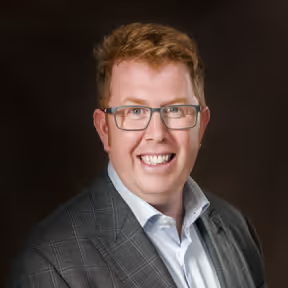

Dr Josh Kempthorne
Orthopaedic Surgeon

"We couldn't be happier with Medow Health. The accuracy of the dictation is incredible, the letters come out perfectly formatted, the setup was so fast and easy and it's saving us both time and money."
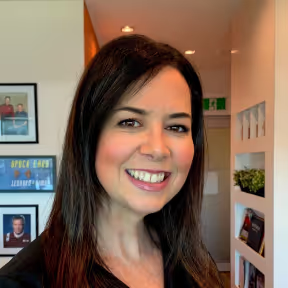
Dani Mathewson
Practice Manager

Pros

  • Best of both worlds: verbatim dictation (your words, your style) combined with AI structuring (right words in the right sections of the letter)
  • No punctuation commands: speak naturally, the AI structures and formats the output automatically
  • Dedicated Specialty-grade AI model per medical specialty: not a general-purpose model
  • Localised Australian dictionary: patient names, hospital references, medication names, Medicare item numbers, college terminology
  • Lookalike/soundalike disambiguation: Losec vs Lasix, hypertensive vs hypotensive, pancreatitis vs pericarditis
  • Any accent, no voice training required: works from the first session
  • Full reports and letters from a single session: consult notes, GP letters, referrals, patient letters, operation reports
  • Anti-hallucination checks: outputs strictly reflect the transcript, nothing inferred
  • Smart Dictation and ambient AI Scribe in one subscription: both modes available, not locked into one
  • Deep bi-directional PMS integrations with Genie (10-min sync), Gentu (min-to-min), Shexie, Elixir, and Meditech
  • Dedicated Customer Success Manager configures templates, tone, and letterheads before go-live
  • ISO 27001 certified: data de-identified before AI processing, regional storage
  • 60-day money-back guarantee

Cons

  • May not suit individual GPs or allied health practitioners seeking a lightweight self-serve free tier

Pricing

Personalised pricing based on usage, specialty, and practice size. Book a demo for a tailored quote. 60-day money-back guarantee.

Which Medical Dictation Software Should You Choose?

The right tool depends on your current workflow, your PMS, and whether you want your words kept with AI structuring, AI-paraphrased notes, accurate speech-to-text with no AI generation, or a human transcription service.

Choose Medow if...

Choose Dragon if…

Choose i-Scribe if…

Choose a Typist if…

You want your exact words kept (with vocal stutters cleaned up) combined with AI structuring — your words in the right sections of the letter, without punctuation commands.
You have a long-established dictation workflow and want accurate speech-to-text with Windows PMS compatibility.
You want a live Gentu integration with letter push and a 14-day free trial.
You have an established typist relationship and are comfortable with 24–72h letter turnaround.
Your PMS is Genie, Gentu, Shexie, Elixir, or Meditech and you need real-time bi-directional sync.
You have a secretary who reviews and finalises outgoing correspondence.
You want a Secretary Login feature for admin staff.
Your secretary or practice manager prefers to manage outgoing correspondence end-to-end and the per-line/per-hour cost works for your volume.
You want a dedicated Customer Success Manager who configures the system before go-live, and a Specialty-grade AI trained for your specialty's clinical reasoning and documentation structure.
Your practice is Windows-based and you dictate directly into Genie, Gentu, or another Windows-compatible PMS. You want speech-to-text accuracy and full control over every word.
You're on Shexie or Best Practice and want an ANZ-native specialist-positioned tool with a free trial.
You prefer not to use software at all.
You want the same platform to support both Smart Dictation and ambient AI scribing, so you are not locked into one mode as your practice evolves.

The Bottom Line  

For clinicians who dictate actively and want accurate speech-to-text with Windows PMS compatibility, Dragon Medical One remains a dependable choice within the limits of what verbatim transcription, on its own, can do: spoken punctuation required, and a cut/paste/reformat step after every letter.

For Australian doctors who want an AI scribe with a free trial and live Gentu integration, i-Scribe is a credible option to evaluate.

For specialist clinics in Australia that need their dictation kept intact (with the AI cleaning up vocal stutters), and want the structure, formatting, Australian-localised dictionary, medication context and PMS sync handled automatically, Medow Smart Dictation is the most complete solution available in 2026. A significant portion of Medow users start with Smart Dictation, and the same platform supports full ambient AI scribing when they're ready to go further.

See Medow Smart Dictation in action
Book a demo to get a personalised walkthrough of Smart Dictation and the AI Scribe, see how Medow integrates with your PMS, and get a quote tailored to your practice. 60-day money-back guarantee.
Book a specialist clinic demoDragon Medical One vs Medow: full comparison
About this comparison. Published 28 May 2026. Pricing, features, integrations and product positioning for all platforms named in this comparison were accurate at time of publication based on each vendor's publicly available information. The AI medical scribe and dictation market is moving quickly and specifics may change. Verify current product details on each vendor's website (Dragon Medical One via microsoft.com, i-Scribe via i-scribe.com.au, Medow Smart Dictation via medowhealth.ai/product/medical-dictation-software) before making a purchase decision. We re-review and update this article on a regular cadence.
Table of content
See how Medow Smart Dictation can transform your clinic — your words, your style, without the punctuation commands or post-dictation formatting work.
Book a demo

Frequently asked questions

What is the best medical dictation software for specialist clinics in Australia?

For specialist clinics, Medow Smart Dictation is the standout option in 2026. It is the only platform that keeps the doctor’s exact words and phrasing intact (cleaning up vocal stutters) while using a dedicated Specialty-grade AI model per specialty to assign each sentence to the correct section of the letter, apply formatting automatically, and sync into Genie, Gentu, Shexie, Elixir, or Meditech without manual re-entry. Dragon Medical One remains the benchmark for active speech-to-text dictation but requires spoken punctuation and does not remove the cut/paste and reformat steps that follow every letter.

What is the difference between medical dictation software and an AI medical scribe?

Medical dictation software (Dragon Medical One being the primary example) converts what the doctor says into text, word for word. The doctor structures and formats the letter themselves. An AI medical scribe records the consultation, understands what was said, and generates a structured letter or report in the model’s own language. Medow offers a third option: Smart Dictation, which keeps the doctor’s exact words and uses a Specialty-grade AI to assign each sentence to the right section of the letter, apply punctuation and formatting, and sync into the PMS. The same platform also supports full ambient AI scribing.

Does medical dictation software work with Genie and Gentu in Australia?

Dragon Medical One works with Genie and Gentu via a floating dictation interface that injects text at the cursor position. This is not a bi-directional integration: appointments do not sync automatically, and the doctor still cuts, pastes, and reformats after every letter. Medow integrates bi-directionally with Genie (every 10 minutes), Gentu (minute-to-minute), Shexie, Elixir, and Meditech: appointments, patient demographics, and completed reports and letters sync automatically without manual re-entry. Mark as Reviewed sends the formatted letter directly into the patient record.

Do I still need to say 'comma' and 'full stop' with AI medical dictation software?

With Dragon Medical One, yes: punctuation must be dictated verbally on every letter. With Medow Smart Dictation, no: the AI adds punctuation, paragraph breaks, and formatting automatically. You speak the way you would to a colleague and Medow structures the output as a complete, formatted letter. Ums, ahs, and restarts are cleaned up automatically.

I have used Dragon for years. Will Medow still sound like me?

Yes. Medow's Smart Dictation uses your exact words and phrasing. The AI removes vocal stutters and places your dictation into the correct clinical format and structure for your specialty. It does not add conclusions or change your clinical reasoning. For specialists switching from traditional dictation, the most common feedback is that Smart Dictation removes steps they had stopped noticing — the spoken punctuation, the post-dictation formatting, the cut/paste into the PMS — while preserving the exact words and clinical reasoning the doctor brought to the dictation.

Is Dragon Medical One still worth using in 2026?

For specialists with long-established dictation workflows, a Windows-based PMS, and a secretary who manages outgoing correspondence, Dragon Medical One continues to deliver reliable, accurate speech-to-text. The case for switching is strongest for clinicians who want to eliminate spoken punctuation, remove the cut/paste and reformat steps after every letter, or move to a tool with deep bi-directional PMS integration. Both Dragon and Medow reduce documentation time: the question is whether the manual steps Dragon leaves in place represent the biggest remaining drag on the workflow.

What is Medow Smart Dictation used for?

Medow Smart Dictation is used for scenarios where the doctor prefers to dictate rather than record an ambient consultation: post-op notes, medicolegal reports, insurance letters, pre-consultation preparation, or when a patient is not present. The doctor speaks naturally, and Smart Dictation keeps the exact words and phrasing, assigns them to the correct sections of the letter, adds punctuation and formatting, and syncs into the PMS. It is the closest equivalent to Dragon Medical One's core use case, with the difference that Medow produces a structured, formatted output rather than raw transcribed text, and uses a Specialty-grade AI model specific to the doctor's specialty.

What is the best Dragon Medical One alternative for specialist clinics in Australia?

For specialist clinics in Australia wanting a Dragon Medical One alternative, Medow Smart Dictation is the most complete option available. It handles the same post-consult and patient-absent dictation scenarios as Dragon, without requiring punctuation commands or voice profile training, and adds automatic letter structuring, Specialty-grade AI formatting, Australian patient name and medication name handling, and deep bi-directional integration with Genie, Gentu, Shexie, Elixir, and Meditech. Unlike Dragon, Medow also supports ambient AI scribing during the consultation, so the same platform covers both the consult recording and the post-consult dictation workflow.

Which practice management systems does Smart Dictation sync with?

Medow integrates bi-directionally with Genie (syncing every 10 minutes), Gentu (minute-to-minute), Shexie, Elixir for New Zealand clinics, and Meditech for hospital settings. Maestro integration is coming soon. Letters approved in Medow sync directly into the patient record — no manual copying required.
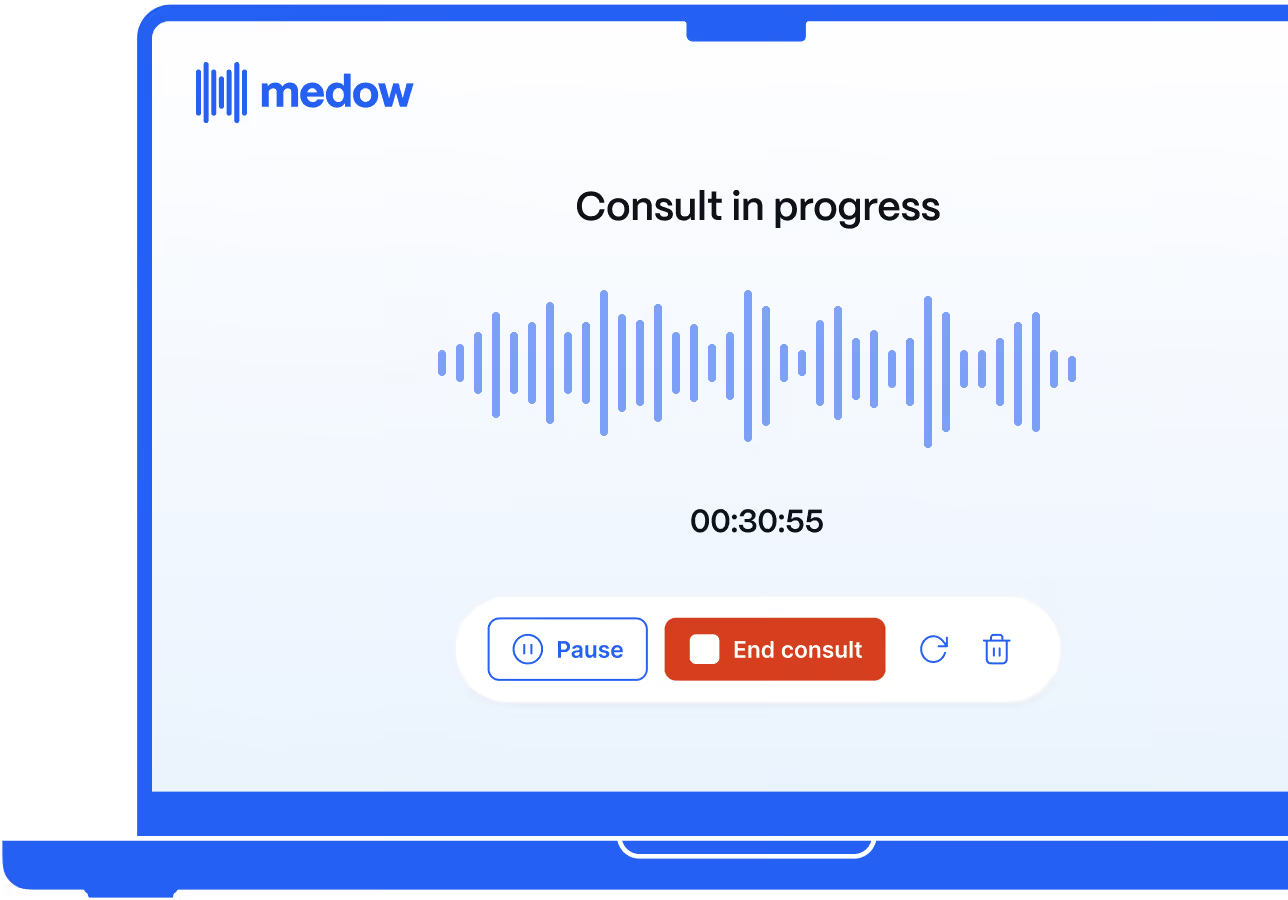
Seeing is believing

Schedule a demo and see first-hand how Medow Health can transform your practice.
Book a demo