Continue with
AI medical transcription uses speech recognition and artificial intelligence to convert spoken clinical content into structured written text. The core steps are audio capture, medical language processing, and draft generation. In the better systems the output is not a raw transcript but a finished report or letter ready for the doctor to review.
Most of these AI transcription tools were built for GPs, not specialists. Specialist clinics produce a wider range of outgoing correspondence, consult letters, referrals, WorkCover and operation reports. Each with its own structure, each read closely by another doctor, and written in vocabulary the general AI models have seen far less of.
This page covers how AI medical transcription works, whether it is reliable enough for clinical use, what it means for medical typists and transcriptionists in Australia, and what specialist clinics should look for when comparing options.
AI medical transcription is the automated conversion of spoken clinical content into written clinical text, using speech recognition trained on medical language.
It runs in three stages.
The third stage is where tools separate. Many generate a consult note or summary. Fewer generate the finished letters a specialist clinic actually sends, which is the difference between saving typing time and largely removing the task.
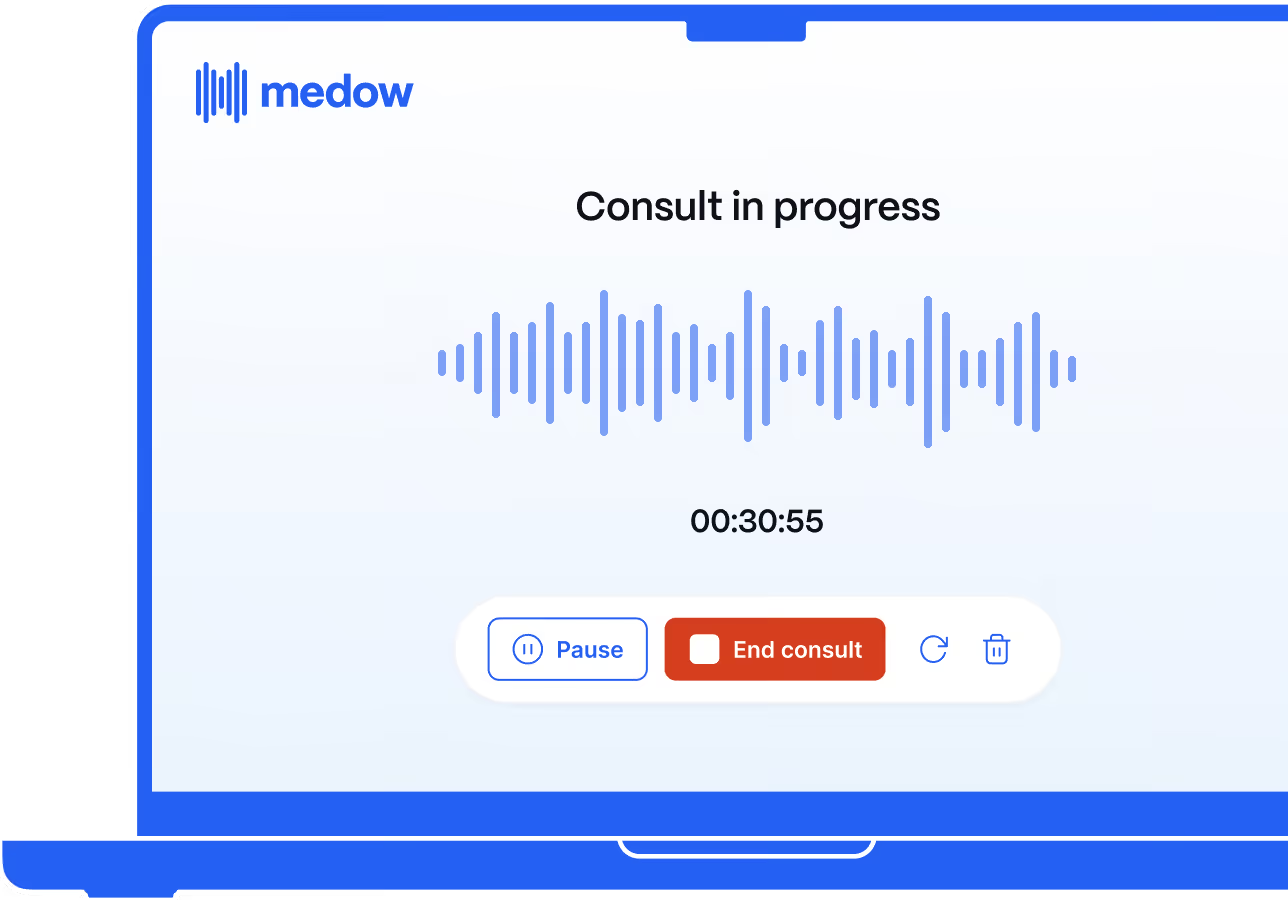
The most familiar route is dictation: the doctor speaks the letter, usually once the patient has left, and the software formats it. The newer route is ambient capture, where the software records the consultation itself. Both use the same underlying speech recognition. Medow supports both, and there is a fuller breakdown of the dictation route in our guide to medical dictation software.
Ambient capture produces something specialist clinics did not previously hold: a verbatim record of the consultation itself. That record serves two purposes. It can be checked against the finished letter, so the doctor can confirm nothing was added or missed. And it stands as a source of truth for what was actually said, which is valuable medicolegally if a question about a consultation comes back months later.
Yes. The more useful question for a specialist clinic is what affects accuracy, and what a given system does when it is uncertain.
Two things. Audio quality, meaning recordings that are muffled or unclear, or a speaker with an accent the system cannot interpret. And vocabulary, meaning how much of your specialty's language the model has been trained on.
If you’re looking for an AI medical transcription tool, the second is the one worth asking vendors about, because it is the variable a clinic cannot fix by buying a better microphone.
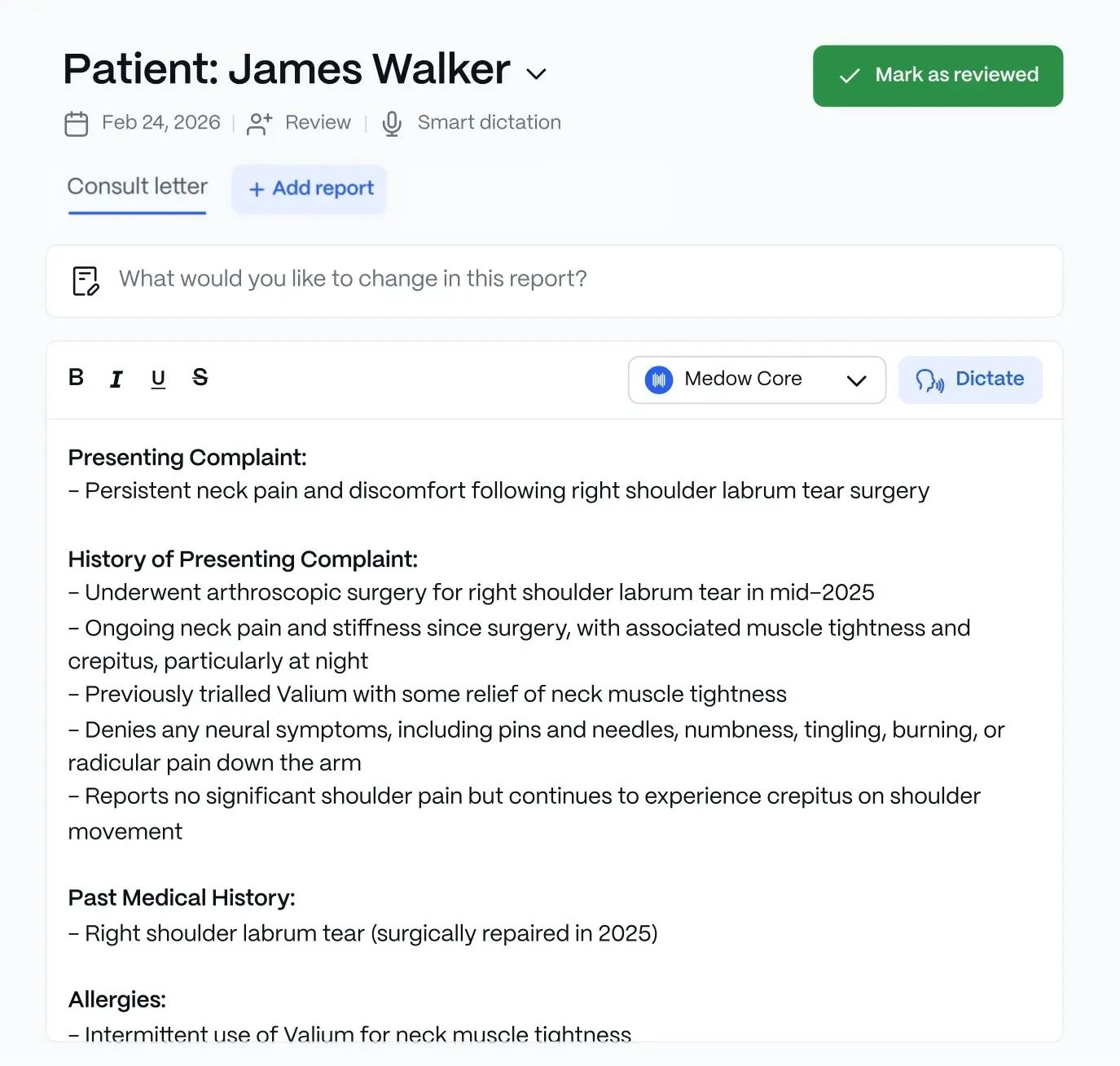
Where audio is unclear, Medow references its training, its contextual understanding of the conversation, and its specialist medical dictionary to select the most probable word rather than the closest phonetic match. If confidence in that word is below 90%, it highlights the word in yellow in the transcript.
The doctor can click the highlight to see a dropdown of the next most likely words, select the right one, or type a correction. That correction is then used to train the model for future occurrences of the same ambiguity.
Consultations with more than one person present are handled as a setting rather than a problem. The doctor selects single or multiple patients before recording, which tells the system to distinguish between speakers. That covers fertility consults, couples counselling, and consultations where a nurse or family member is in the room.
Before a letter reaches the doctor, Medow runs verification checks against the transcript so the generated output contains no diagnoses or conclusions the doctor did not state. The doctor reviews and approves every letter regardless.
See it handle your specialty's terminology
The fastest way to judge accuracy is on your own consultation type and your own vocabulary. Book a demo and see how Medow transcribes and drafts for your specialty.
For a specialist clinic, the best AI medical transcription is one built for specialist practice rather than adapted from general practice. Four things separate the options.
This is the difference that shows up in every letter. A general model applied across all of medicine has seen far less of your field's vocabulary than a model trained for it. Ask how many models the vendor runs, and whether there is a specialist dictionary behind each one.
A transcript leaves the formatting with you. Specialists produce a wide range of correspondence, each with its own structure and audience. A tool that outputs one generic note format covers a fraction of the actual workload.
A letter that has to be copied and pasted has not removed the task. For Australian and New Zealand specialist clinics the systems that matter are Genie, Gentu, Elixir, Shexie, and Meditech. Check whether the connection is a genuine API or a surface-level overlay. Details are on the integrations page.
Specialist letter formats are too particular for a blank template to serve well. Some platforms are self-serve: you configure templates and workflows yourself after signing up, and outputs improve as you correct them. The alternative is a vendor that configures your letter formats and tone before you see your first patient, so the outputs are right from the first consultation.
Medow is Specialist-Grade AI: a clinical documentation platform built for specialist clinics in Australia, New Zealand, and Singapore. Against the four criteria above:
Medow runs over 50 separate specialty-trained AI models rather than one general model with templates applied on top. Each has its own clinical dictionary, its own structural rules, and its own monthly update cycle, with dictionaries localised for Australia, New Zealand, and Singapore so they recognise local hospitals and branded medications. You can check whether your specialty is covered, from cardiology and psychiatry through to maxillofacial surgery and rheumatology. Patient data is never used as a training input.
From one consultation Medow generates consult letters, referral letters, patient letters, WorkCover reports, operation reports, consult notes, discharge letters, and custom templates configured for the clinic. Letters are written in the individual doctor's voice: three sample letters build a Voice Profile, and every letter after that reads the way that doctor writes. Doctors average around 30 seconds editing a letter.
Genie syncs every ten minutes and Gentu minute to minute, alongside Elixir, Shexie, and Meditech. All are deep API connections. Appointments and patient demographics pull in automatically and finished letters sync back without re-entry.
Every clinic is assigned a dedicated Customer Success Manager who sets up letterheads, templates, structure, and tone using samples of the doctor's existing letters, before go-live. That person stays as the ongoing contact, and their feedback feeds model refinement.
Patient data is stored in the customer's region and hosted in Australia on Microsoft Azure, which is HIPAA compliant. Medow is ISO 27001 certified. Personally identifying information is de-identified before entering any AI model. Doctors obtain patient consent before recording, in line with Australian Privacy Principles.
Dr Michael Hanlon, Orthopaedic Surgeon
“Being able to dictate a letter and have it typed instantly for real-time review has been a game-changer. It saves me and my secretary Marlene hours each week, and letters now go out the same day instead of waiting days to get through all the typing.”
Dr Sam Shales, Orthopaedic Surgeon
“Now before I leave for the day, the patient's letters are already written and approved. It's gone from two weeks down to one day.”
In the clinics Medow works with, the typing drastically reduces. Admin staff move toward correspondence checking, patient coordination, and clinic flow. One ENT surgeon says his scribe now assists with procedures and helps check letters and notes instead of typing them. An orthopaedic surgeon says his PAs are no longer stuck typing up dictations. Letters still need a human eye before they go out; what changes is that the eye is checking rather than typing. More accounts are on our testimonials page.
The correspondence load is not shrinking. Consult letters, referrals, patient letters, WorkCover reports, operation reports, and discharge summaries all still have to be produced. What changes with AI is how they are produced: the audio no longer has to travel to a person and come back as text that still needs formatting. Outsourced services typically return work in 24 to 72 hours. If you are weighing that comparison specifically, we cover it in our guide to medical transcription services in Australia.
In practice, yes. The terms are used interchangeably and vendors pick different words for the same capability. If you are comparing platforms specifically, see our guide to the best AI medical scribes in Australia.
Accuracy depends on two things: audio quality, and how much of your specialty's vocabulary the model has been trained on. Medow addresses the second with a dedicated model and specialist dictionary per specialty. Where audio is unclear, it uses clinical context to select the most probable word and highlights anything it is less than 90% confident in, so the doctor reviews flagged words rather than hunting for silent errors. The finished letter is also checked against the transcript before the doctor sees it.
Yes. Smart Dictation is built for situations with no patient present, such as post-operative notes and medicolegal reports. The doctor speaks naturally with no dictation commands and Medow applies punctuation, formatting, and structure. Nearly 30% of Medow users start on Smart Dictation. For specialists moving across from traditional dictation software, our Dragon Medical One comparison covers the differences.
Yes. Medow supports in-person, telehealth, and pre-recorded consult modes. The consult mode is selected before recording begins, and telehealth consultations are transcribed and documented to the same standard as in-person consults.
Yes. Genie syncs every ten minutes and Gentu minute to minute, with Elixir, Shexie, and Meditech also supported, all via deep API integration. Appointments flow in and completed letters sync back into the patient record automatically.
The billing model matters as much as the number. Outsourced transcription services bill per audio minute or per line, so the cost scales directly with clinical activity: a busier clinic pays proportionally more. Medow is priced as a monthly subscription. There is a fuller cost comparison in our guide to medical transcription services in Australia, and pricing for your clinic is covered in a demo.
Setup is completed by Medow's Customer Success team and typically takes two to three business days. Templates, tone, letterheads, and practice management integrations are configured before the doctor has access to the platform, so there is nothing to configure yourself.
Yes. Doctors obtain patient consent before starting a recording, in line with Australian Privacy Principles. The requirement applies whether the documentation is produced by AI or by a person.