Continue with


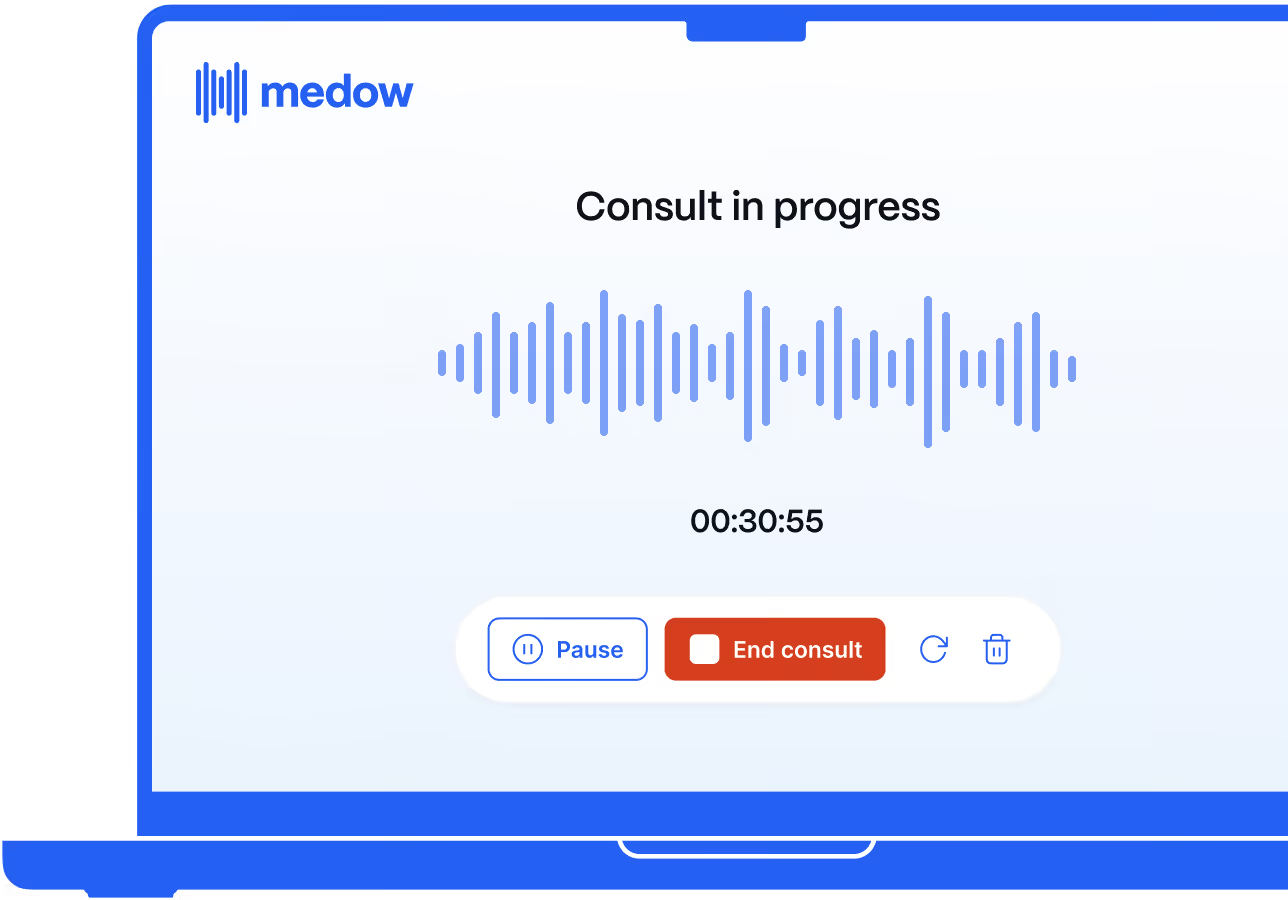
For orthopaedic spine surgeon Dr Andrew Kanawati, an initial consultation letter that took 10 minutes to dictate and check now takes a little over 60 seconds, and he no longer spends Saturdays checking them. Before Medow, every consultation meant a letter to dictate, and every dictated letter had to be checked the next day. Today, Andrew gives the patient his full attention, knowing Medow is capturing everything. When he stops recording, he knows Medow has captured all of the patient’s information and that the letter will appear a few seconds later. He proofreads it in a little over a minute, exports it to Genie and sends the letters out before moving on to the next patient.


Andrew’s practice runs on Genie, and Medow connects to it through a direct integration. When a consultation ends, the letter is waiting in Medow. He checks it, exports it to Genie, and it is ready to send. That speed changes what he can offer in the room. When a patient asks for a letter before they leave, such as a referral to a pain specialist or medical certificate, Andrew asks them to wait outside for five minutes. As he puts it, “I check it and it exports to Genie and it’s sent before they’ve left.” Patients are impressed by how quickly the letter appears:

It’s in their language. It’s so good. And they’re so impressed. They say, ‘How did the doctor do this so quickly?’
Before Medow, Andrew did much of the work of a consultation in his head. Before the patient arrived, he read through the documents and had to hold on to the exact dates, the injury and the specific level of the spine. In the room, he was already thinking about what he would need to dictate, and he preferred not to take handwritten notes because they took his eyes off the patient. There was plenty of detail to keep track of, such as mechanism of injury or who the patient worked for. Andrew describes it as “a lot of brain power”.
The frustration carried on after the consultation. Towards the end of a long appointment, Andrew would start planning the dictation, realise he had missed a detail and go back to ask the patient again. “Now I’m backtracking and just wasting time,” he says. Then came the dictation itself, rewinding and re-recording to get it right. His summary of the whole process is short: “I hated it. It was terrible.” Today, thanks to Medow, that load has gone.
Now Medow’s AI just listens to all of that, and I know that it’s just going to turn up in the letter.
Andrew trusts Medow to capture everything said in the room and to turn it into an accurate letter. He is no longer rehearsing the dictation or carrying the patient’s history in his head, so the consultation can stay on the person in front of him.
Before AI scribes, Andrew dictated every letter. Dictating and checking each one took about 10 minutes, and the checking happened the next day. After a Friday of consults, that meant Saturday was 45 minutes of checking letters while taking his daughter to her piano and sports lessons.
A typical morning session now has three to four new patients and around eight follow-ups. Each letter arrives moments after he stops recording, and he proofreads it in between patients while the consultation is fresh. Checking takes a little over a minute. Across a morning session, he estimates the saving at an hour at least, and more after a busy afternoon. He says Medow has really cut down that Saturday letter work.
Andrew used another AI scribe for a year before moving to Medow. It was better than no AI, he says, but it fell short in three ways that matter to a surgeon:
The letters from other AI Scribes sometimes sounded not very professional. It wasn’t very intuitive. It wasn’t specialist focused.
Medow is built for specialist medicine, with a dedicated AI model for each specialty, trained on that field’s terminology and documentation requirements. It also draws on Andrew’s own templates and macros so the letters sound just like he’d written them.
Medow also sounds like Andrew. He works from three templates: initial consultation, follow-up and post-op. His initial letters open with a line summarising the problem and close with a one- or two-line summary of the problem and the plan, the only parts he reads when he goes back to a letter if he is rushed for time. His follow-up and post-op letters are brief, a couple of sentences that draw on the initial consultation and include only what is relevant. He describes the letters as “so eloquent”.
Medow does that perfectly for me. It knows the way I like to format my letters.
Medow records what the patient says, so the details are exact. Where Andrew might once have dictated “February 2025”, Medow puts in the exact date the patient gives.
It also works from the GP’s referral letter. Medow lists the patient’s medications, so the ones that matter to a surgeon, such as blood thinners and pain medicines, are easy to find. The letters are clinically relevant as a result.
The change Andrew values most is what no longer happens once a letter has gone out.
Very rarely have I had to change a letter because there’s a wrong detail. Actually, probably never.
Before Medow, he sometimes had to change a dictated letter after it had been sent, because a patient had called to say something in it was wrong.
Whereas before, if I dictated something, patients would often call up and say, ‘This detail in the letter is wrong.’ Now with Medow, I don’t have to worry about that because it transcribes exactly what the patient says, often verbatim.
Medow’s patient profiles link each patient’s consultations together, and Andrew had been hoping for them for about a year. When they arrived, he was blown away:
It was mind-blowing. When Medow did the patient profiles, that was the best.
Before profiles, preparing for a session meant cutting and pasting the referral letter, reports and radiology into Medow, and the initial consultation letter for each follow-up. Now Andrew doesn’t have to. Andrew describes the change:
For the follow-up appointment, I’d get the initial consult letter, and cut and paste it into Medow. But now I open the Medow consult first before I even open the patient’s file in Genie and I just read the patient’s profile on Medow.
It also means a check of a bone scan starts with what the previous scan showed.
Andrew also uses Medow on his mobile. Because Medow is web-based, he can pull up a patient’s profile wherever he is, which he can’t do with his practice’s server. When a GP, pharmacist or radiologist calls, he has the patient’s history in front of him.
I use Medow as my mobile database because I can still look up files.
For letters to lawyers, where AI can’t be used, Andrew uses Medow’s Smart Dictation instead.
I use the smart dictation on Medow. I’ll dictate it to Medow and it polishes the text for me.
Andrew has one dedicated Customer Success Manager at Medow, Solveigh. He has found that single point of contact really useful, particularly for tailoring Medow to his specific style of writing so the AI sounds like him.
Asked what he would say to a surgeon who is hesitant about using an AI scribe, Andrew’s answer was short.
I’d never go back. I couldn’t. It’s just too good.